Real Estate Answering Service for Yard Sign Calls and Texts
Key Takeaways
- A real estate answering service picks up calls and texts from your listing sign when you are in a showing, asks a few qualifying questions, and passes the lead to you with notes.
- Voicemail and shared office lines lose sign call leads because a buyer standing in front of a house rarely leaves a message and often calls the next agent.
- Research on lead response found that contacting a lead within an hour made it nearly seven times more likely to qualify than waiting even one more hour.
- The best setup books showings straight into your calendar, flags hot buyers and seller inquiries for an immediate callback, and texts anyone it cannot reach.
- Pricing models vary (per minute, per call, or flat monthly), so compare against what a single missed listing inquiry is worth to you.
What is a real estate answering service for yard sign calls?
A real estate answering service is a call and text handling service that answers your business line, qualifies the caller, books showings, and routes serious leads to the agent. For yard signs, it answers the number printed on the sign when you cannot, whether a human team or an AI voice agent such as InstantReply.ai does the work.
Sign call leads are different from portal leads. The caller is usually standing at the property or driving past it, interested right now, and one tap away from calling a different agent's sign down the street.
What happens when a buyer calls the sign while you are out showing another home?
The call is answered on the first ring, the caller is asked a few short questions, and a showing is offered before they hang up. You get a summary by text or email. Without that, the call goes to voicemail and the buyer usually moves on.
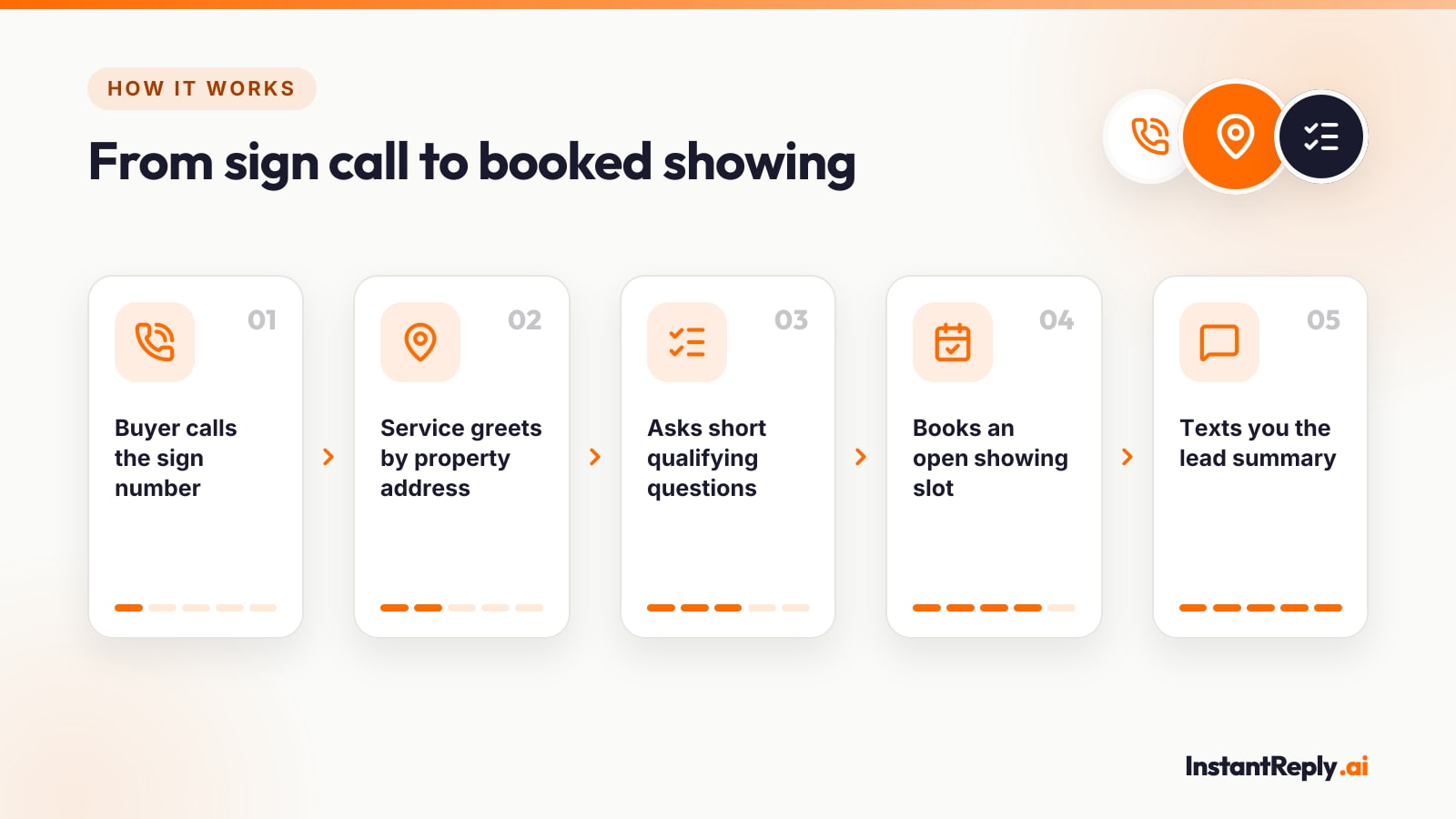
Here is the sequence on a well-configured setup:
- The buyer dials the number on the sign. The service picks up and greets them by property address.
- It confirms what they want: a showing, the price, or details on the home.
- It asks qualifying questions: are they working with an agent, are they pre-approved, what is their timeline.
- It checks your calendar and offers open showing slots.
- It books the slot, texts the buyer a confirmation, and sends you the lead summary.
A buyer at the curb wants an answer in the next minute, not a callback after your showing ends.
If the caller is a seller asking "what would my house sell for," the service flags the lead as a listing opportunity and alerts you right away, since that call is worth more than most showings.
How much does a slow reply cost on a sign call lead?
Slow replies cost you the lead's attention while it is still warm. According to a Harvard Business Review study of online sales leads, as hosted on ResearchGate, firms that contacted a lead within an hour were nearly seven times as likely to qualify it as firms that waited even one hour longer.
That research covered web inquiries across many industries, not real estate sign calls specifically. The direction still applies: interest fades fast, and a sign call is about as immediate as an inquiry gets.
Imagine you list four homes and each sign gets about three calls a week. Say you miss a third of them while showing or driving, and a few of those callers would have bought or listed. Even one extra closed deal a year, at a commission of, say, $9,000, outweighs most monthly service fees. That is an illustrative example, not a benchmark, so plug in your own numbers.
How does an answering service compare with voicemail and a shared office line?
An answering service beats voicemail and a shared office line on speed, qualification, and booking. Voicemail captures a message at best. A shared office line depends on whoever is free, and that person may not know the listing.
| Feature | Voicemail | Shared office line | Answering service |
|---|---|---|---|
| Answers on first ring | No | Sometimes | Yes |
| Knows the listing address | No | Rarely | Yes, per sign number |
| Qualifies buyer or seller | No | Inconsistent | Yes, with set questions |
| Books showings | No | Manual, later | Yes, into your calendar |
| Works after hours and weekends | Message only | Usually closed | Yes |
| Alerts you to hot leads | No | Depends on staff | Yes, by text or call |
Voicemail records a message. An answering service holds the conversation and books the showing before the buyer calls someone else.
A shared line has another hidden problem: the person answering handles agents' calls, vendor calls, and walk-ins, so sign callers get whatever attention is left.
How does it qualify buyers and sellers without annoying them?
It asks three to five short questions in a natural order, then stops. Over-questioning loses callers, so the script should get to a showing offer quickly and collect extra detail through a follow-up text.
Typical qualifying questions for a buyer:
- Which home are you calling about, and are you at the property now?
- Are you already working with an agent?
- Are you pre-approved or paying cash?
- When do you want to move?
For a seller, the questions shift to the property address, timeline, and whether they have spoken with another agent. The service then marks the lead hot, warm, or cold so you know who to call first.
Can an answering service book showings automatically?
Yes. It can read your calendar, offer open times, book the slot, and send a confirmation and reminder. That means buyers get a showing without waiting for you to call back, and you are not trading texts to find a time.
Automatic booking also helps after the showing. Appointment reminders cut no-shows, and a follow-up text after the visit keeps the conversation alive. Leads that are not ready can drop into lead nurture sequences, so a buyer who called in March is not forgotten by June.
handles this flow as an AI voice agent: it answers sign calls, qualifies the lead, books the showing, and texts you the summary, with SMS follow up if the caller drops off.
What about texts and missed calls from the sign?
Many buyers text the number on a sign instead of calling, and a missed call needs a reply too. A good service answers both: two way texting for inbound messages and a missed call text back when a call cannot be picked up.
If someone calls and hangs up, an automatic text such as "Thanks for calling about 42 Maple Street, want to schedule a showing?" can recover that lead in seconds. Email and WhatsApp inquiries from listing portals deserve the same speed, so check that the service covers every channel your listings send traffic to.
How do the options and prices compare?
Options range from live human operators to AI voice agents, and prices vary by model. Always check current rates on each provider's pricing page, since per-minute, per-call, and flat monthly plans are not directly comparable.
- Human answering services such as Smith.ai, Ruby, and AnswerConnect use live receptionists. They handle nuance well but often bill per minute or per call, which adds up during busy weekends.
- AI voice agents such as InstantReply.ai answer every call at once, have no per-minute staffing cost to scale, and are usually cheaper for high call volume. They are strongest on routine qualification and booking.
- Real estate lead platforms such as Ylopo focus on ad leads and nurture, and may not cover a sign number as the main use case.
If you are searching for a cheap answering service for a small business, compare the cost per answered call against the value of one booked showing, not just the monthly fee. For property management, the best fit is the one that triages maintenance calls and handles after hours cover as well as leasing inquiries.
How do you set up an answering service for a listing sign?
Set up a dedicated number per listing or per agent, forward it to the service, and load the property details and your calendar. A sign number you can swap or retire keeps your personal cell off printed signs.
Give each listing sign its own number so you always know which property a call is about.
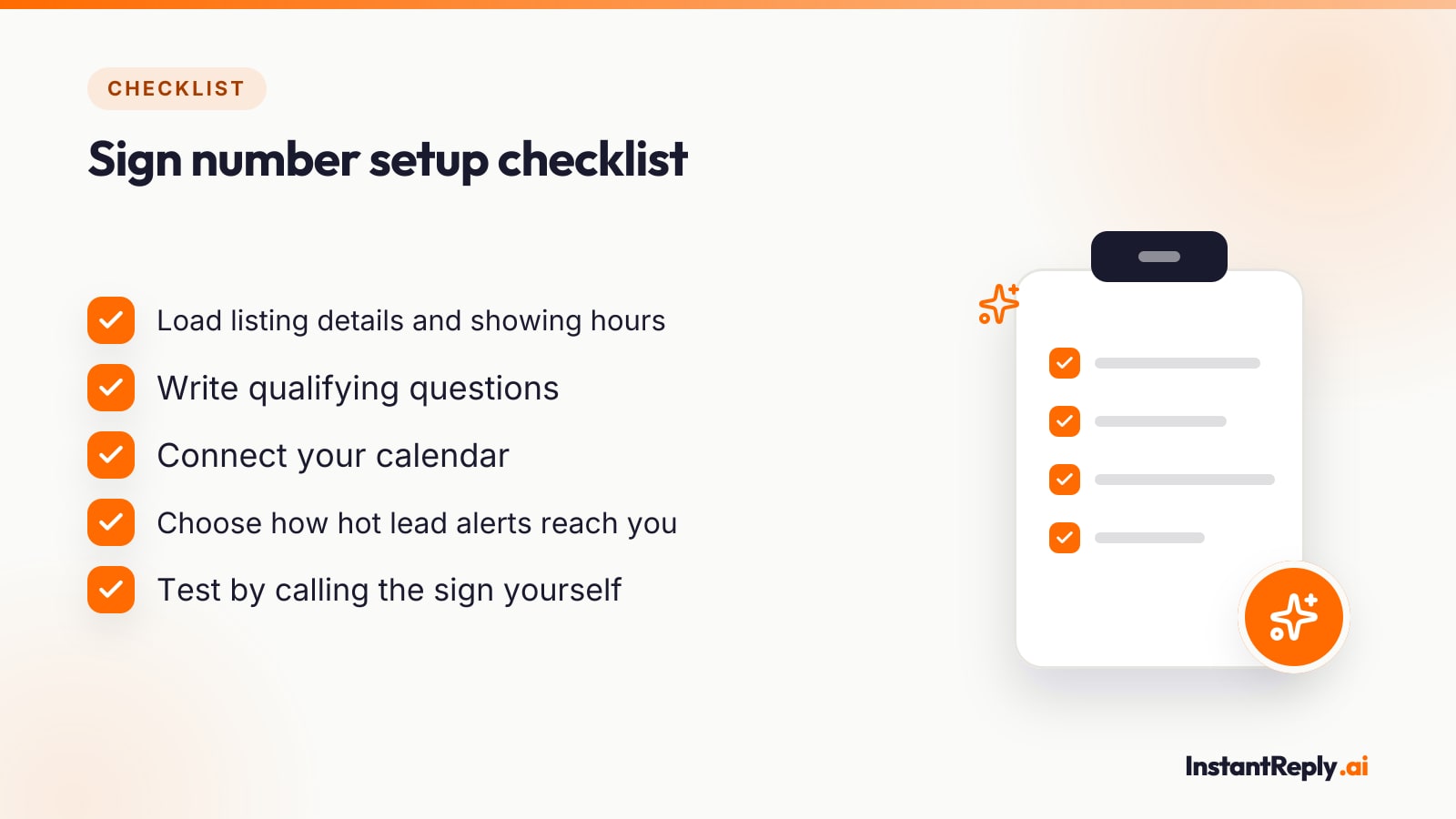
Before you go live, work through this list:
- Load the address, price, key features, and showing availability for each listing.
- Write the qualifying questions and decide what counts as a hot lead.
- Connect your calendar and choose how alerts reach you (text, call, or email).
- Test by calling the sign number yourself from outside the house.
- Review call summaries weekly and adjust the script.
How should you start this week?
Pick your busiest listing, put a dedicated number on its sign, and route it to the service for one week. Compare answered calls, booked showings, and callbacks against your last week on voicemail. The gap shows what your current setup costs you.