No-Heat Call at 2am: What Your HVAC Answering Service Does
Key Takeaways
- An HVAC answering service picks up a no-heat call at 2am, collects the address, system details, and safety information, sorts it by urgency, and either dispatches the on-call tech or books the first morning slot.
- Voicemail loses most of these calls because a person with a dead furnace usually calls the next company instead of waiting. A live human call center answers but costs more and often cannot see your schedule. An AI answering service answers instantly and can book directly.
- Send gas smells, carbon monoxide alarms, and no-heat calls with vulnerable occupants to the on-call tech (or to 911 and the gas utility first). Routine comfort calls can wait for a morning booking.
- Set your emergency rules, service area, on-call rotation, and booking slots before the first cold night, then test the line with real scenarios.
What does an HVAC answering service do when a no-heat call comes in at 2am?
An HVAC answering service answers your business line outside office hours, gathers the details a dispatcher needs, decides how urgent the call is, and either alerts your on-call tech or books a visit. The caller reaches something useful at 2am instead of a ringing phone or a mailbox.
The goal is not to chat. It is to turn a stressed caller into a confirmed next step: a tech on the way, or a firm morning appointment with a text confirmation.
An AI answering service does this with an AI voice agent that follows your rules. , for example, answers inbound calls, asks your intake questions, checks your calendar, and texts the caller a confirmation. A missed call text back covers anyone who hangs up before the conversation finishes.
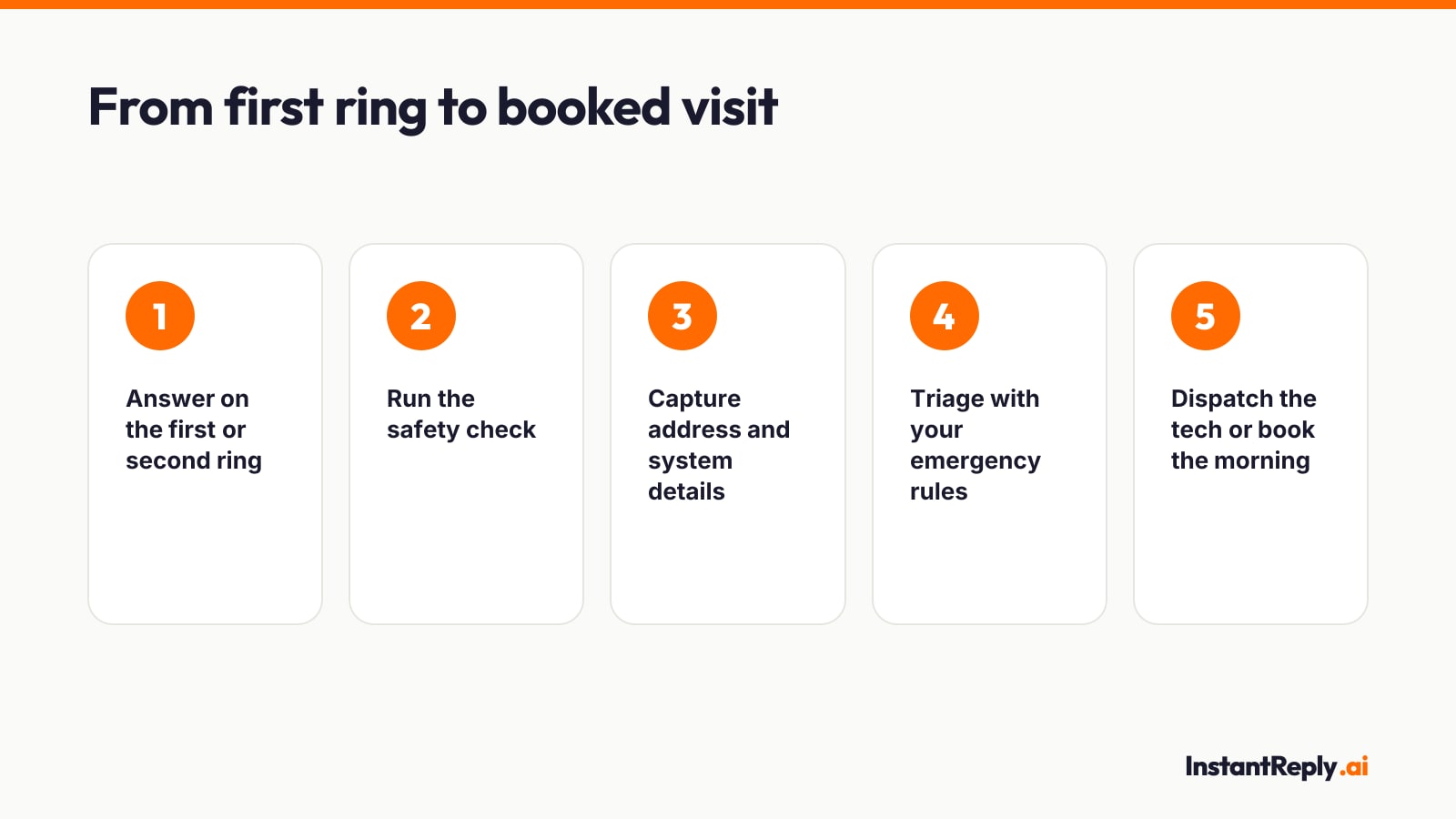
How does a no-heat call go from first ring to a booked visit?
A no-heat call moves through five steps: answer, safety check, intake, triage, and booking or dispatch. Done well, the whole sequence takes a few minutes and ends with the homeowner knowing exactly what happens next.
| Step | What happens | What the caller gets |
|---|---|---|
| 1. First ring | The line is answered on the first or second ring with your company name | A live voice, not a mailbox |
| 2. Safety check | Asks about gas smell, carbon monoxide alarm, and who is in the home | Immediate safety instructions if needed |
| 3. Intake | Captures name, address, callback number, system type, and what the equipment is doing | No repeating themselves later |
| 4. Triage | Applies your emergency rules to decide urgency | A clear answer on timing |
| 5. Dispatch or booking | Pages the on-call tech, or books the first morning slot | A text confirmation with the plan |
A no-heat caller at 2am is not shopping for a bargain. They want a voice that confirms someone is coming.
The caller's own words matter less than the sorted facts. "Furnace is making a clicking noise and nothing happens" becomes a structured ticket: system type, symptom, thermostat setting, and whether the home has infants, elderly residents, or medical equipment.
How do voicemail, an HVAC call center, and an AI answering service compare?
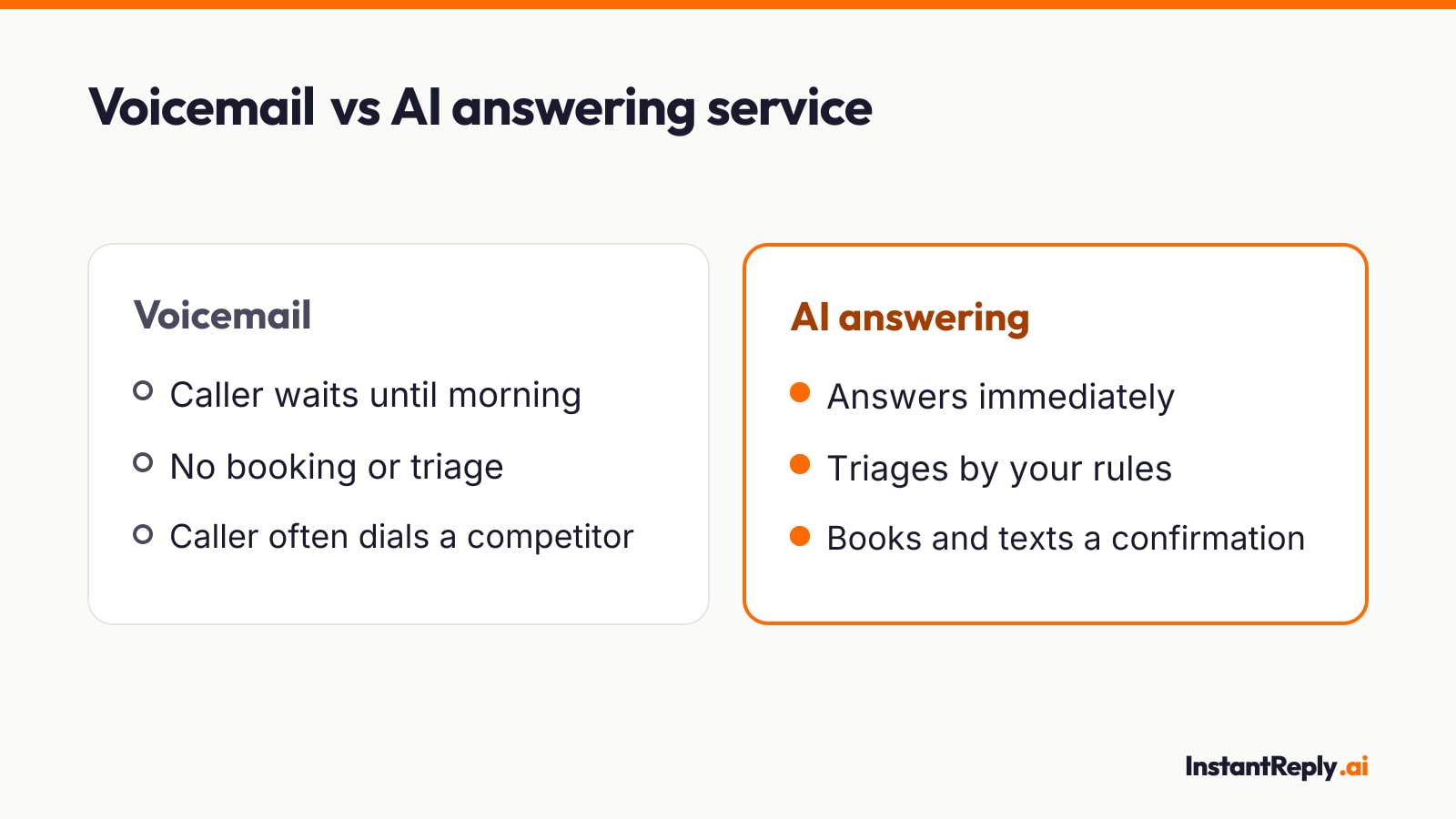
Voicemail is free but passive, a traditional HVAC call center is human but expensive and often disconnected from your schedule, and an AI answering service answers instantly and can book into your calendar. The right choice depends on call volume and how much of the process you want automated.
| Voicemail | Traditional HVAC call center | AI answering service | |
|---|---|---|---|
| Answers live | No | Yes | Yes |
| Wait to reach someone | Until you wake up | Usually short, can queue in a cold snap | Immediate, including during surges |
| Sees your schedule | No | Often not, takes a message | Yes, when connected to your calendar |
| Books the appointment | No | Sometimes, depends on setup | Yes |
| Handles many calls at once | No | Limited by staff | Yes |
| Judgment on odd situations | None | Strong | Good on scripted cases, escalates the rest |
| Cost pattern | Free | Per-minute or per-call, scales with volume | Typically a flat or usage-based software fee |
Check each vendor's current pricing yourself. Rates vary widely and change.
Voicemail asks the customer to wait. A cold house does not let them.
A middle path works for many shops: AI answers and books everything, and a human only joins for calls the rules flag as unusual.
Which HVAC emergency calls should go to the on-call tech?
Send a call to the on-call tech when there is a safety risk, a vulnerable person in a cold home, or a failure that can cause property damage by morning. Everything else can be booked for the first available slot.
If a caller smells gas or a carbon monoxide alarm is sounding, the first instruction is to leave the home and call 911 or the gas utility. The answering service should say so before anything else, then alert your tech.
| Call type | Route to | Why |
|---|---|---|
| Gas smell or CO alarm | Safety instructions first, then on-call tech | Life safety |
| No heat with infant, elderly, or medically fragile occupant | On-call tech | Health risk overnight |
| No heat with freezing temperatures forecast | On-call tech | Frozen pipes and property damage |
| Burning smell, smoke, or visible sparking from equipment | Safety instructions, then on-call tech | Fire risk |
| Water leaking from a furnace, boiler, or heat pump | On-call tech | Damage grows by the hour |
| No heat, mild weather, healthy adults | First morning slot | Can wait safely |
| Noisy system, weak airflow, uneven temperatures | Next business day | Comfort issue |
| Quote request or maintenance inquiry | Next business day with follow-up | Not urgent |
Write these rules down once. Your answering service then applies the same logic at 2am that you would apply at noon.
What does a missed 2am no-heat call actually cost?
A missed emergency call usually costs you the job, because a caller with no heat keeps dialing until a company answers. The loss is not only one repair: it can include the replacement quote, the maintenance plan, and the referrals that customer would have sent.
Here is an illustrative example, not real data. Say your area sees six after hours no-heat calls in a cold week, you miss half of them, and the average ticket is $450. That is about $1,350 in lost revenue for the week, before counting any system replacements among those callers.
Your own numbers will differ, so pull last winter's call log and count the unanswered after hours calls. Most owners are surprised by how many rang out.
Who are the best HVAC answering service options?
The best HVAC answering service is the one that answers every call, applies your emergency rules, and writes to your schedule, so compare options on those three points rather than on feature lists. The market includes live-agent call centers, general AI receptionists, and tools built specifically for HVAC.
Vendors that market AI receptionists to HVAC and home service companies include Nexa HVAC, Ansa, and Automyx, each with its own focus. Traditional specialty answering service providers staff live operators who learn your scripts. Features and pricing change, so verify current details on each vendor's site before deciding.
InstantReply.ai fits owners who want one platform covering more than the phone. Beyond the AI voice agent, it handles AI SMS follow up, two way texting, AI email follow up, and AI WhatsApp automation. It also supports appointment reminders, no show recovery, quote follow up, and review and referral requests. Ask any vendor for a recorded test call using your own after hours scenarios.
What is the setup checklist for an HVAC owner?
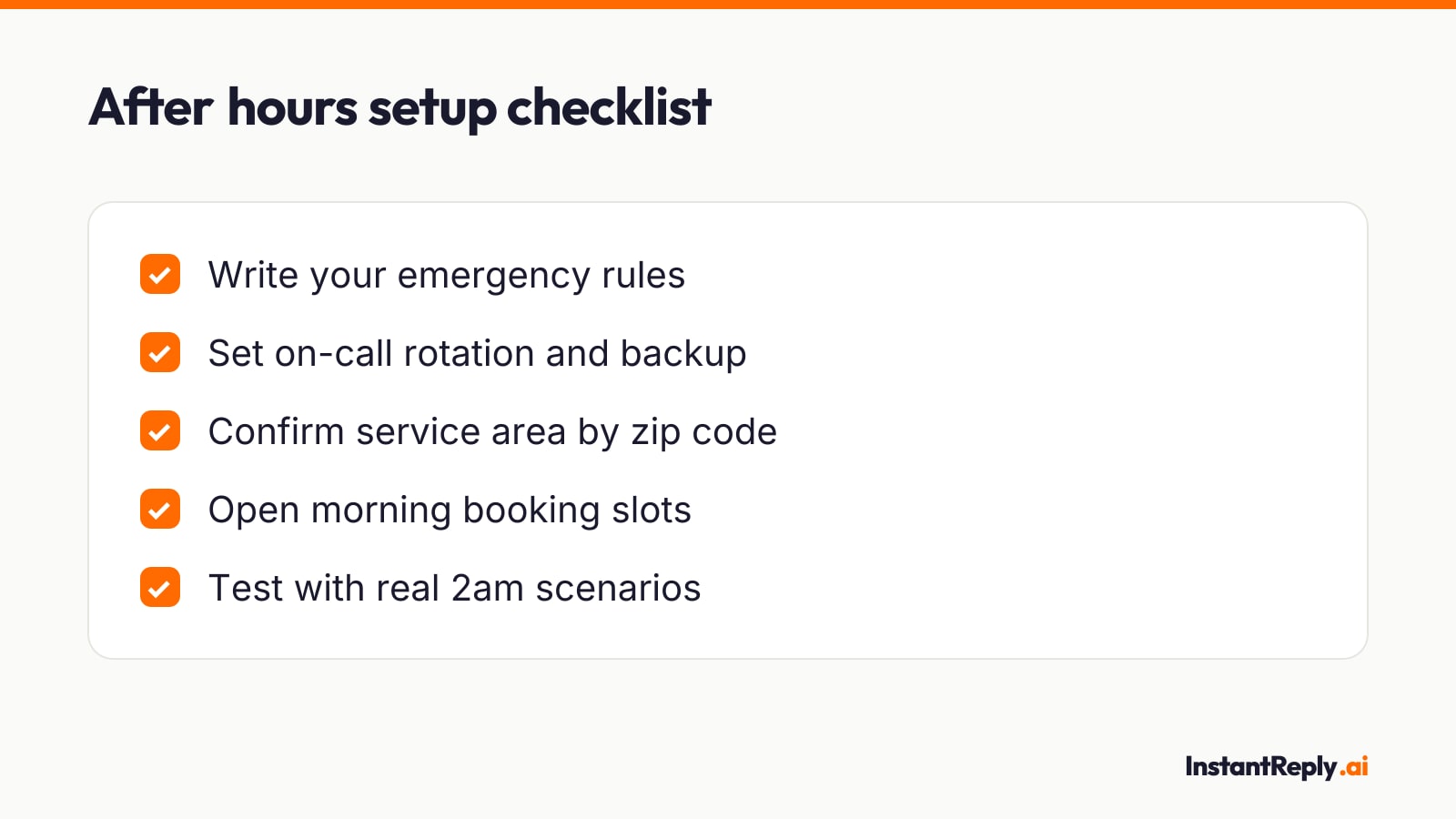
Setup takes a few decisions, not a long project. Define what counts as an emergency, who is on call, which areas you serve, and which slots the service may book, then test before cold weather arrives.
- Write your emergency rules using the table above, including your freezing-temperature threshold.
- Set the on-call rotation with a primary tech, a backup, and an escalation time if nobody responds.
- Confirm your service area by zip code so out-of-area callers are handled politely.
- Open morning booking slots the service can fill without asking you.
- Decide your after hours fee language and what the caller hears about it.
- Connect your calendar, CRM, or dispatch software so bookings land where your team already works.
- Turn on missed call text back so dropped calls still get a reply.
- Test with real scenarios: gas smell, elderly occupant, mild-weather no-heat, wrong number.
- Review the first week of transcripts and adjust the rules.
Add follow-up after the visit: a reminder before morning appointments, a review request once the system is running, and a lead nurture sequence for callers who asked for a replacement quote but have not booked.
Where does an AI answering service fall short?
An AI answering service can mishandle unusual situations, heavy accents on poor connections, or callers who are too upset to answer questions. It works best with clear rules and a human escalation path.
Plan for these edge cases. Let the caller say "talk to a person" at any point, and route that request to your on-call tech. Review transcripts regularly, because the first few weeks reveal gaps in your rules. Keep the safety script simple and conservative: when in doubt about gas or carbon monoxide, the answer is always to leave the home and call emergency services.