Key Takeaways
- A restaurant telephony AI host is a voice agent that answers the restaurant's existing phone number, takes an order in natural conversation, confirms it back, and sends it to the kitchen or POS, with no app, no website, and no sign-in for the caller.
- The Amazon Connect build pattern is: Connect handles the phone number and call flow, a real-time speech layer handles listening and speaking, a language model handles the conversation, and a Lambda function checks every item against the live menu before the order is confirmed.
- The hard part is not the AI. It is menu grounding (never offering an item that is 86'd), modifier handling, noisy kitchen audio, and a clean handoff to a human when the call goes sideways.
- Build it yourself when you need deep POS integration and control. Buy a managed when you mainly need missed calls answered, after hours cover, and follow up across text, email and WhatsApp without hiring engineers.
- The same architecture that takes a pizza order takes a service booking, so HVAC, dental, legal, real estate and insurance operators can reuse the pattern for AI appointment booking and faster inbound lead response.
What is a restaurant telephony AI host, and what does it actually do on a call?
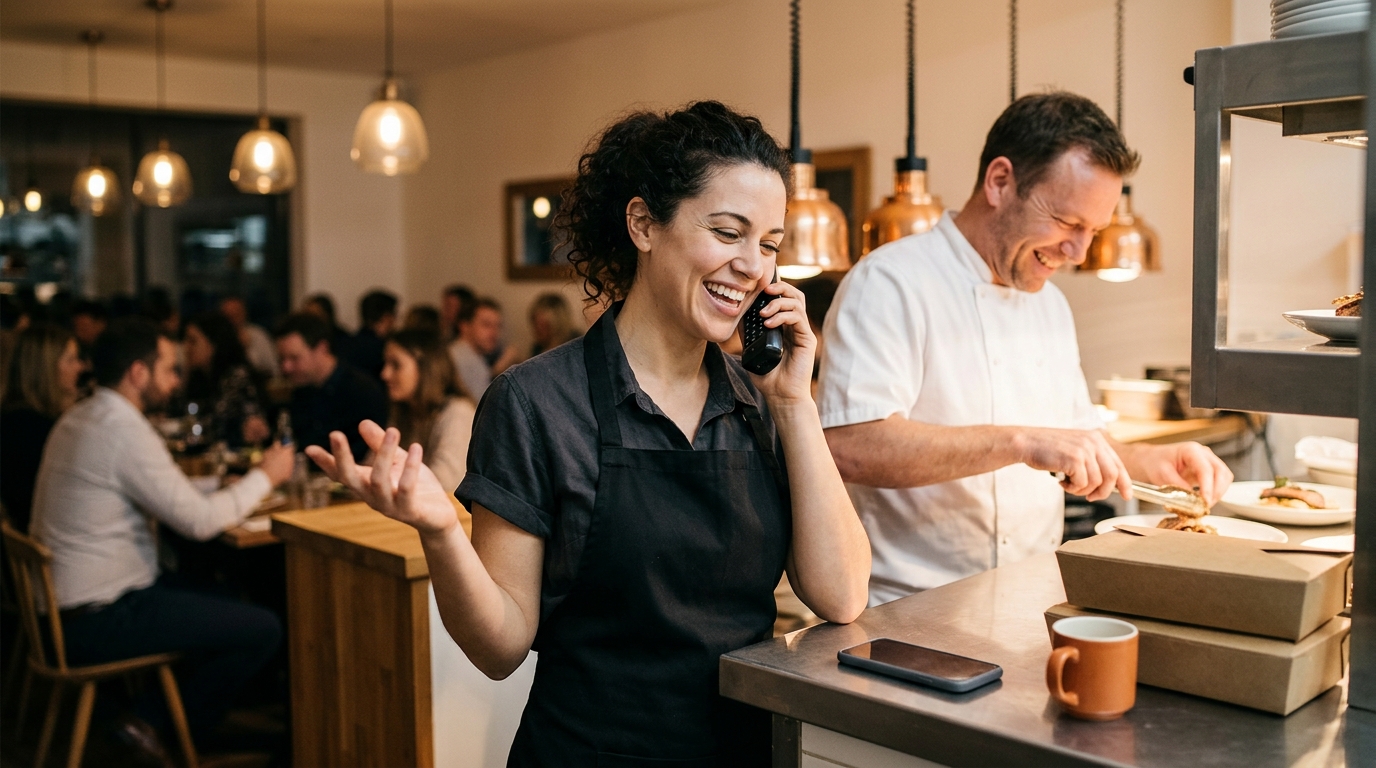
A restaurant telephony AI host is an AI voice agent that picks up the restaurant's phone line, greets the caller, takes the order item by item, handles modifiers and substitutions, reads the order back, quotes a total and a pickup time, then writes the order into the kitchen system. The caller does nothing but talk. No app download, no website, no account.
The end to end flow on a typical call looks like this: the phone rings and is answered on the first or second ring, the agent asks pickup or delivery, walks the menu on request, catches "no onions, extra cheese", confirms the full order aloud, captures a name and callback number, and hangs up. The order appears on the kitchen display or POS before the caller has parked.
That last detail matters more than any model choice. An order that lands in a spreadsheet nobody watches is not an order. The integration to the kitchen is the product.
Why do restaurants lose money on missed calls during a rush?
Restaurants lose money on missed calls because the busiest hour is also the hour nobody can reach the phone. A ringing line during a Friday dinner rush gets ignored, sent to a voicemail no one checks, or answered by someone holding a hot pan. The caller does not leave a message. They call the next restaurant.
The cost is invisible because there is no record of it. A voicemail at least leaves a trace. An abandoned ring leaves nothing, so the operator never sees the revenue that walked. Pulling the call detail records off your phone system and counting unanswered inbound calls between 5pm and 9pm is usually the most uncomfortable report an owner runs all year. Industry analysis by HungerRush puts the annual cost of unanswered phone orders at over $27,000 for a typical restaurant.
For example, say a restaurant misses eight calls a night, converts half of those recovered calls into orders at a $38 average ticket, and trades six nights a week. That is roughly $47,000 a year sitting in the missed call column. The maths is illustrative, but plug in your own numbers and the shape rarely changes.
What does the Amazon Connect architecture look like end to end?
The architecture has four layers: telephony, real-time speech, reasoning, and business logic. Amazon Connect owns the phone number and the contact flow. A real-time speech layer streams caller audio in and synthesised speech out with low latency. A language model runs the conversation. AWS Lambda functions validate menu items, price the order, and push it to the POS.
Which AWS services do what?
Amazon Connect provides the cloud contact centre: claim or port a number, build the contact flow, set business hours, and route to a human queue when needed. See the Amazon Connect administrator guide for how flows, queues and routing profiles fit together.
The conversational brain is typically a model hosted on Amazon Bedrock, driven by a system prompt that defines the host's persona, the ordering steps, and the rules it must never break. Amazon Connect's own agentic voice capability handles barge-in, turn taking and streaming speech so the caller can interrupt naturally instead of waiting for a beep.
AWS Lambda holds the deterministic logic: look up the item, apply the modifier price, check stock, calculate tax, create the ticket. Amazon DynamoDB stores the menu, the session state and the order record. Post-call messaging, such as an order confirmation text, goes out through AWS End User Messaging.
The design rule that keeps the system honest: the model decides what to say, Lambda decides what is true. Prices, availability and totals never come from the model's memory.
How do you stop the AI inventing menu items or prices?
You stop hallucinated menu items by grounding every item in a live lookup. The model proposes an interpretation of what the caller said, then a function call checks that item against the menu database. If the item, size or modifier does not exist, the function returns a failure and the agent asks a clarifying question instead of confirming something the kitchen cannot make.
Three practical guardrails do most of the work:
- Menu as data, not prompt. Keep the menu in DynamoDB with item IDs, sizes, allowed modifiers and an availability flag. The prompt describes behaviour, not inventory. When a dish is 86'd, staff flip a flag and the agent stops offering it on the next call.
- Confirm before commit. The agent reads the full order back with the total before writing anything. Callers correct errors at that moment, which is far cheaper than fixing them at the counter.
- Constrained output. The order is assembled as structured data with fixed fields, so an item either resolves to a real SKU or it does not exist.
How does it handle noise, accents, and messy real orders?
It handles messy calls by expecting them. Real ordering calls have kitchen noise, car noise, side conversations, half-sentences, changes of mind, and callers who order in a different order than your flow expects. The agent must accept "actually, make that two, and cancel the fries" at any point and re-read the corrected order.
Barge-in support is non-negotiable. If a caller has to wait through a scripted list before speaking, they hang up. The agent should stop talking the moment the caller starts.
Set an explicit failure path. Two consecutive misunderstandings on the same item, and the agent stops guessing: it either transfers to a human or takes a callback number and triggers a text message. Silent looping is the fastest way to lose a customer permanently.
What does it cost to run, and how do you work out the payback?
Costs are usage based. Amazon Connect pricing charges for service usage per minute plus telephony per minute, and you pay separately for model inference on Amazon Bedrock, Lambda invocations and database reads. There are no per-seat licences, so the bill scales with call volume rather than headcount.
The bigger cost is engineering. A production build needs someone who can write and maintain contact flows, Lambda functions, POS integration and monitoring, plus the ongoing work of tuning prompts when the menu changes.
Work out payback on recovered orders, not on labour saved. For example, imagine recovering twelve orders a week at a $38 ticket. That is about $23,700 a year in revenue that previously rang out. Compare that against your build hours plus monthly usage and you have your answer in one line.
When should the AI hand the call to a human?
The AI should hand off on complaints, large catering or group bookings, payment disputes, allergy questions with real risk attached, and any call where the caller asks for a person. Build the transfer into the Amazon Connect contact flow from day one, with a warm summary passed to the staff member so the caller does not repeat themselves.
Also plan for after hours cover. Outside trading hours the agent should not take an order it cannot fulfil. It should state the next opening time, offer to take a pre-order for the next service, and send a missed call text back so the customer has something in their hand.
Should you build on Amazon Connect or buy a managed AI receptionist?
Build on Amazon Connect when you have engineering capacity, deep POS or kitchen display integration needs, multi-location routing, and a reason to own the whole stack. Buy a managed when the goal is simply that every inbound call, text, email and WhatsApp message gets answered fast, and you would rather spend the next six weeks on the business than on contact flows.
Build gives you control over latency, prompts, data residency and integrations. It also gives you an on-call rotation, a deployment pipeline and a maintenance burden.
Buy gives you an AI answering service that is live in days, with missed call text back, two way texting, AI appointment booking, lead nurture sequences and appointment reminders already wired together. The trade is less control over the internals.
Most independent restaurants should buy. Groups with an in-house dev team and a custom POS should look hard at building, because that is where a bespoke Amazon Connect host earns its keep.
How does the same pattern work for HVAC, dental, legal or real estate?
The same pattern works because taking an order and booking a job are the same conversation with different fields. Swap menu items for service types, pickup times for appointment slots, and the kitchen ticket for your calendar or CRM, and you have an AI voice agent that turns inbound calls into booked appointments.
For an HVAC company, the agent captures the fault, the address, the equipment type and the urgency, then offers real slots from the dispatch calendar. For a dental clinic, it books, reschedules and runs appointment reminders to cut no shows. For a law firm, it runs intake screening and routes conflicts to a human. For an insurance agent, it captures the quote request and starts the quote follow up.
The follow up layer is where most of the extra revenue hides. AI SMS follow up on unanswered calls, AI email follow up on open quotes, AI WhatsApp automation for customers who prefer chat, plus no show recovery, cold lead reactivation and review and referral requests. Answering the call fast fixes lead response time. Following up automatically fixes everything after it.
What should you measure once it is live?
Measure answer rate, containment rate, order accuracy, transfer rate and revenue per answered call. Answer rate tells you whether calls are still being lost. Containment tells you how many calls finished without a human. Accuracy tells you whether the kitchen trusts it. Revenue per answered call tells you whether any of it is worth doing.
Review a sample of transcripts weekly for the first month. Most failures cluster into a handful of repeatable causes: an unclear menu name, a missing modifier, an accent the speech layer stumbles on. Each one is a small fix, and each fix compounds across every call that follows.