After-Hours Pest Calls: How an AI Receptionist Books Jobs
Key Takeaways
- A pest control answering service picks up calls nights and weekends. An AI receptionist does it without a per-minute human payroll, sorts urgent jobs from routine ones, and books the inspection during the call.
- Urgency rules decide what happens next. Wasps by a front door or rodents in a kitchen get a priority slot or an on-call alert. A termite question during a home sale gets a dated inspection. A few ants in a bathroom can wait for the next opening.
- Voicemail loses jobs because the homeowner calls the next company on the list. An AI receptionist keeps the caller on the line and ends with a booked time.
- A text follow-up after the call confirms the visit, collects the address and photos, and sets up the pitch for a recurring plan once the first treatment is done.
- The money is in the plan, not the first visit. Say a one-time job is worth $150 and a recurring plan $400 a year: converting after-hours callers into plan customers is where the revenue compounds.
What is a pest control answering service, and why do after-hours calls matter?
A pest control answering service picks up inbound calls when your office is closed or your techs are on a job, captures the details, and ideally books the visit. An AI version, such as InstantReply.ai, does this with a voice agent that talks to the caller, asks the right questions, and writes the appointment straight into your schedule.
Pest problems do not keep office hours. A homeowner finds wasps at the door on a Saturday morning, hears scratching in the walls at 10 p.m., or gets a termite report back on a Sunday while a home sale is days from closing. Those people call the first number they find, and many will not leave a voicemail.
The cost of slow response is documented. According to Harvard Business Review's 2011 study of lead response, firms that contacted a web inquiry within an hour were nearly seven times as likely to qualify the lead as firms that waited even one hour longer. That study looked at web leads, but the same logic applies to a panicked homeowner who is already dialing your competitor.
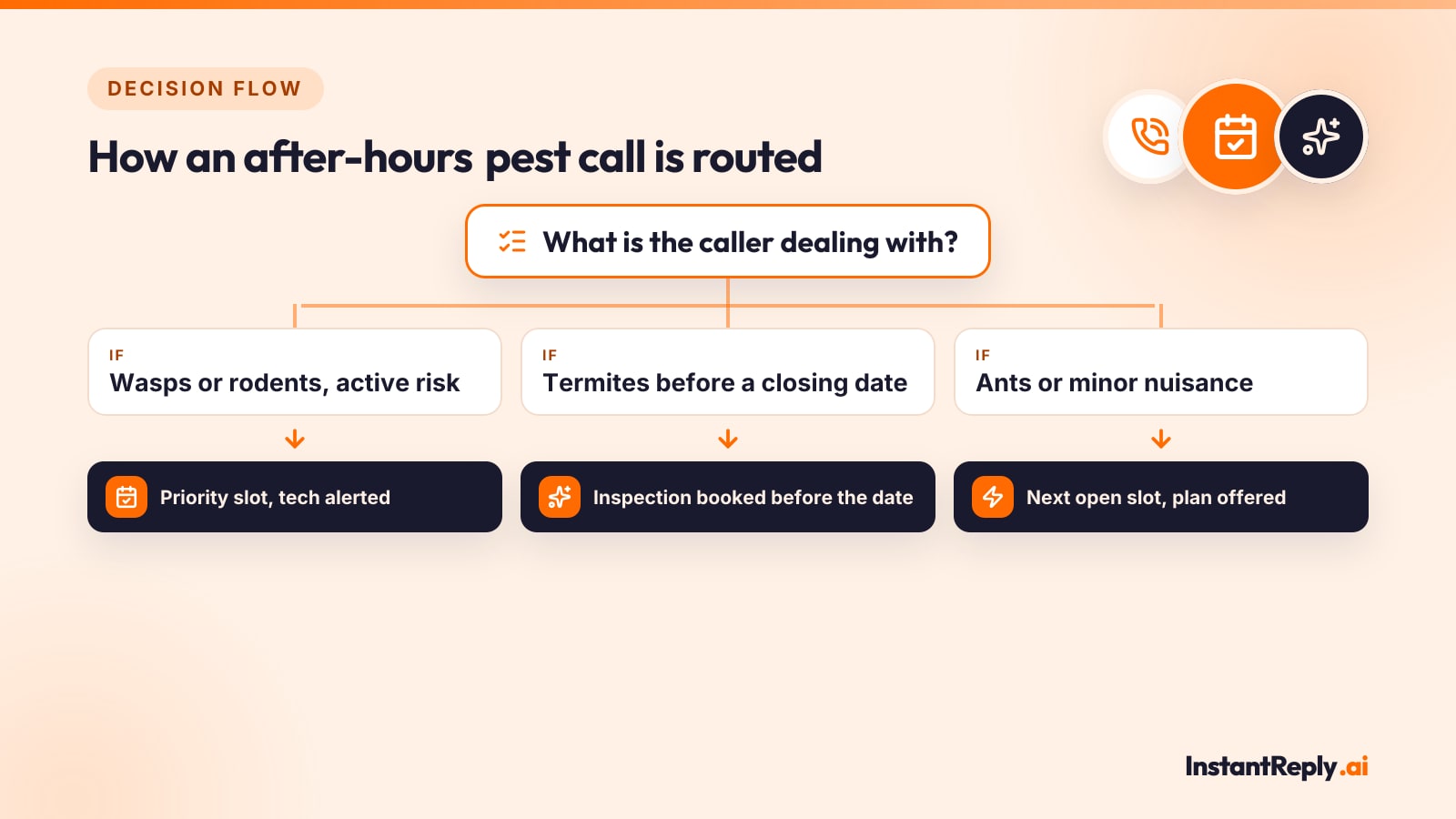
How does an AI receptionist tell an urgent pest call from one that can wait?
An AI receptionist asks a short set of questions, scores the answers against rules you set, and routes the job. Active stinging insects near an entrance, rodents in a food area, and time-boxed real estate inspections go to the top. Cosmetic or low-risk issues get the next open slot.
You decide the rules once. InstantReply.ai then applies them on every call, at 2 a.m. or on a holiday, without a tired person making judgment calls.
| Caller situation | Urgency | What the AI receptionist does |
|---|---|---|
| Wasps or hornets by a door, kids or pets at risk | High | Offers the earliest slot, alerts the on-call tech if you allow it |
| Rodents in a kitchen or pantry | High | Books priority inspection, asks about droppings and entry points |
| Termite concern during a home sale | High (date-driven) | Asks for the closing or inspection date, books before it |
| Bed bugs reported in a bedroom | Medium to high | Books a fast inspection, texts prep instructions |
| Ants in a bathroom or yard | Low | Books next available, offers a plan quote |
| General pricing question | Low | Answers from your price guide, offers to book |
Wasps by the front door and a termite report before closing are both urgent, but for different reasons, and the agent books each accordingly.
The rules cover the questions that matter: what the pest is, where it is, whether anyone has been stung or bitten, whether a sale or lease date applies, and whether it is a house, rental, or business. The same triage pattern works for an HVAC AI answering service sorting a no-heat call from a tune-up request, so the approach carries over if you run more than one trade.
Voicemail vs. an AI receptionist: which books more after-hours jobs?
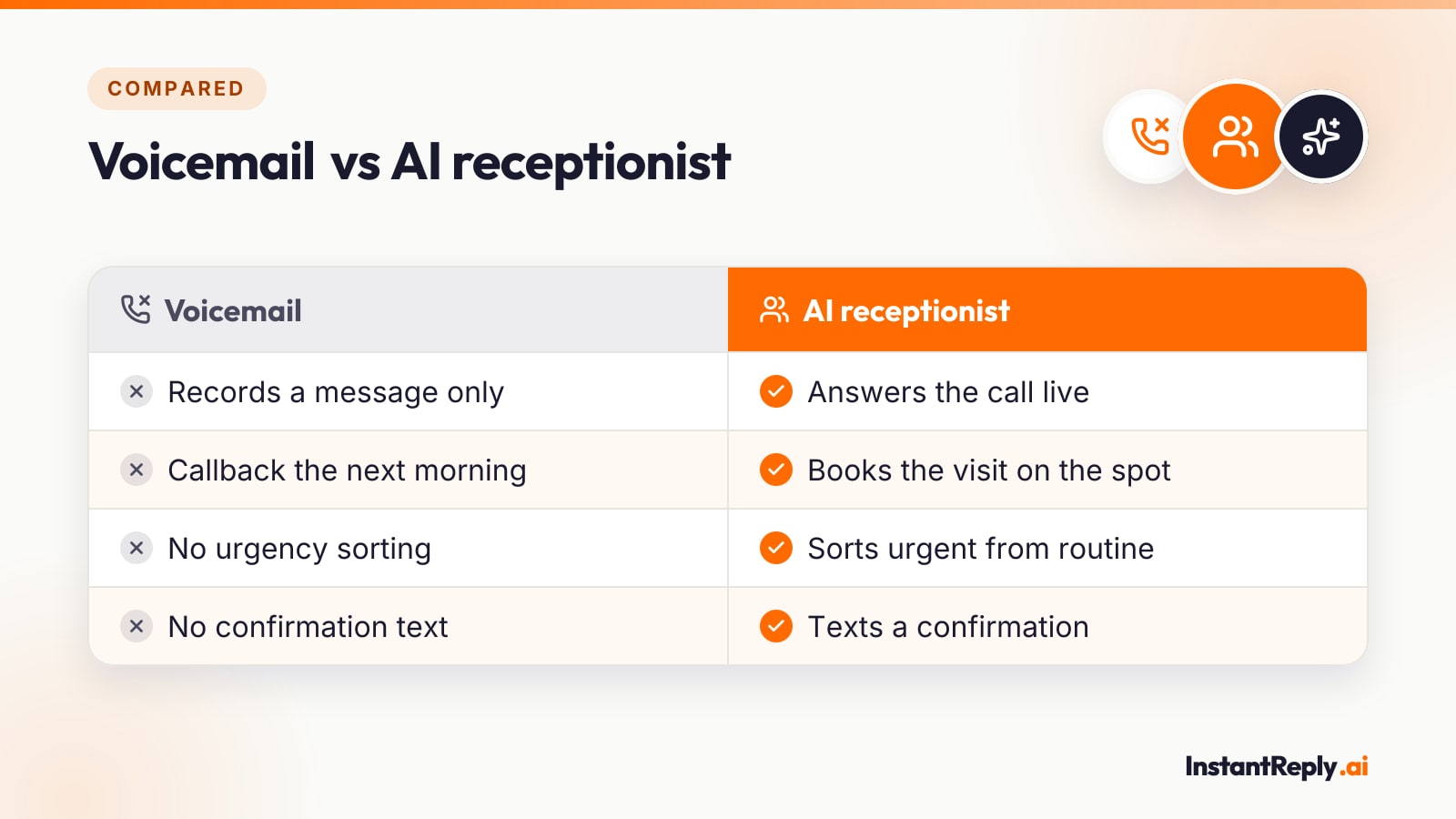
An AI receptionist books more after-hours jobs because the caller gets an answer and a time slot instead of a beep. Voicemail asks a stressed homeowner to wait, and many will call the next company instead. The difference shows up in booked appointments, not in call volume.
| Voicemail | AI receptionist | |
|---|---|---|
| Answers the call live | No | Yes |
| Sorts urgent from routine | No, you listen the next morning | Yes, during the call |
| Books the inspection | No, someone calls back | Yes, on the spot |
| Sends a confirmation text | No | Yes |
| Handles two calls at once | No | Yes |
| Works holidays and weekends | Records only | Answers and books |
| Captures address and pest details | Only if the caller offers | Asks every time |
Voicemail records the problem. An AI receptionist solves the scheduling part of it before the caller hangs up.
Human answering services such as Ruby and Smith.ai are a legitimate middle option. They put a live person on the line, which some owners prefer. The tradeoff is that a human service typically charges by volume or minutes and depends on how well your scripts and calendar rules are followed. An AI agent costs less to scale for spiky call volume, such as the first warm weekend of spring when every wasp nest is discovered at once.
What does a text exchange with a homeowner look like?
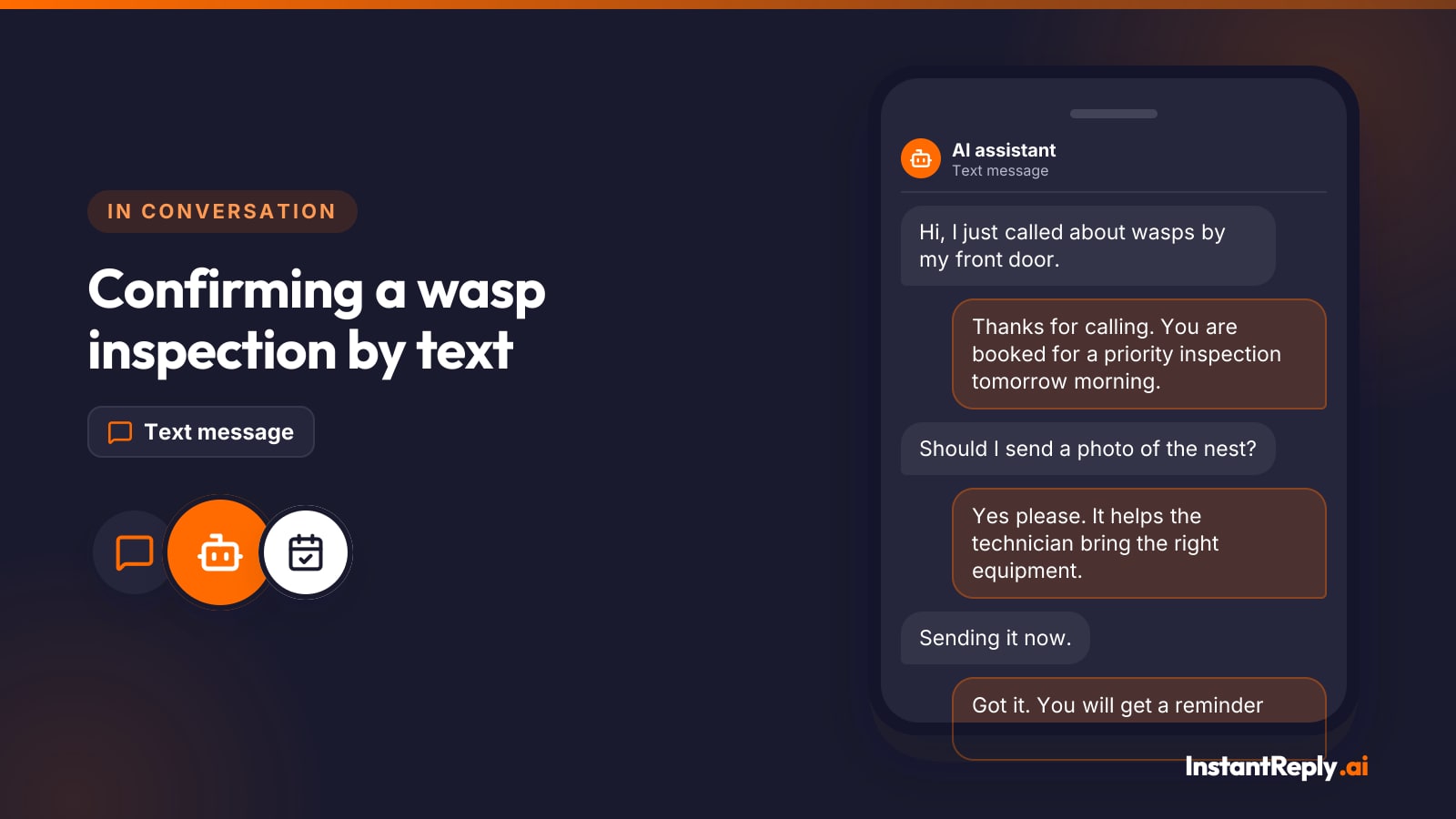
After the call, the AI receptionist can continue in two-way texting to confirm the visit, collect the address, and request a photo. The goal is to remove back-and-forth so your tech arrives knowing what they are treating. The exchange stays short and ends with a clear next step.
Here is a sample exchange after a Saturday call about wasps. It is an illustration, not a transcript.
Homeowner: Hi, I just called about wasps by my front door.
Assistant: Thanks for calling. I have you down for a priority inspection tomorrow between 9 and 11. Can you confirm the address?
Homeowner: Yes, it's the one I gave on the phone. Should I send a photo of the nest?
Assistant: Yes please. A photo helps the technician bring the right equipment. Please keep kids and pets away from the door until then.
Homeowner: Will do. Sending it now.
Assistant: Got it. You will get a reminder tomorrow morning with the technician's arrival window.
Each text does a job. The first confirms the booking, the second fills a gap in the details, and the third sets up an appointment reminder that cuts no-shows. For jobs that slip, the same channel supports no show recovery by offering a new time rather than letting the lead go cold.
How do one-time treatments become recurring pest control plans?
A one-time treatment becomes a recurring plan when someone asks at the right moment with the right offer. The AI receptionist can plant the idea during the booking call, then follow up by text after the job with a plan quote while the problem is still fresh in the homeowner's mind.
The sequence is simple:
- At booking: the agent mentions that quarterly service is available and asks if the caller wants a quote after the first visit.
- After the treatment: a text thanks the customer, confirms the issue is resolved, and offers the plan price.
- A few days later: a lead nurture sequence checks in with one reminder, not a barrage.
- At the renewal window: a message offers to schedule the next visit before the pests come back.
- After a good visit: a review and referral request goes out while the customer is happy.
The first visit pays for the truck. The recurring plan is what builds the business, and a follow-up text is how most plans get sold.
Customers who decline can enter cold lead reactivation later, such as at the start of the next season when wasps, ants, and rodents return. Quote follow up works the same way: an unanswered estimate gets a polite nudge instead of silence.
How much is an unanswered after-hours call worth?
An unanswered after-hours call is worth the first-visit fee plus the chance of a plan, multiplied by how many calls you miss. The exact figure depends on your pricing, but a simple worked example shows the scale.
Say your company gets 10 after-hours and weekend calls a week and loses most of them to voicemail. Imagine an AI receptionist books 3 more inspections a week at $150 each. That is about $23,400 a year (3 x 52 x $150). If one in three of those customers signs a $400 annual plan, that adds roughly $20,800 more (52 plans x $400). These are illustrative numbers, so swap in your own call volume and prices.
Missed calls also cost you indirectly. A homeowner who reaches voicemail once rarely gives you a second chance, and they are unlikely to refer you. A missed call text back helps recover some of them, but a live answer with a booked time is stronger.
What should you check before choosing an AI answering service for pest control?
Choose a service that can triage by your rules, book into your real calendar, and text the customer afterward. Test it with your own scenarios before you commit, because a polished demo can hide weak handling of urgent calls and odd addresses.
Before you sign up, check these points:
- Can it ask pest-specific questions and apply your urgency rules?
- Does it book into your actual schedule without double-booking?
- Can it transfer to a human or alert an on-call tech for true emergencies?
- Does it send confirmation texts, reminders, and follow-ups?
- Does it handle service area limits and politely decline jobs you do not cover?
- Can it also handle texts, email, and WhatsApp, not only calls?
covers the voice, text, email, and WhatsApp side in one setup, so an after-hours caller who later texts gets the same context. If you only need a person reading a script, a human service like Ruby or Smith.ai may fit better. Pick based on how many calls you miss and how much you want to automate, not on the longest feature list.